

Dr. Leroy Butler, DO, FAAOS, is a foot and ankle fellowship-trained orthopedic surgeon who treats end-stage ankle arthritis in Frisco and Dallas. He specializes in advanced ankle care, including total ankle replacement and ankle fusion. This guide explains the two primary surgical options for severe joint damage, the criteria for candidacy, and how to navigate your care at Leroy Butler, DO PLLC.
Understanding End-Stage Ankle Arthritis
End-stage ankle arthritis is a condition where the cartilage covering the bones of the ankle joint has worn away completely. This leads to bone-on-bone contact, causing chronic pain, stiffness, and difficulty walking. When conservative treatments like physical therapy, orthotics, and injections no longer provide relief, surgical intervention becomes the standard of care. At Leroy Butler, DO PLLC, we focus on subspecialty care for these complex joint issues. The decision between surgery types depends on your age, activity level, and the specific pattern of joint damage.
Total Ankle Replacement
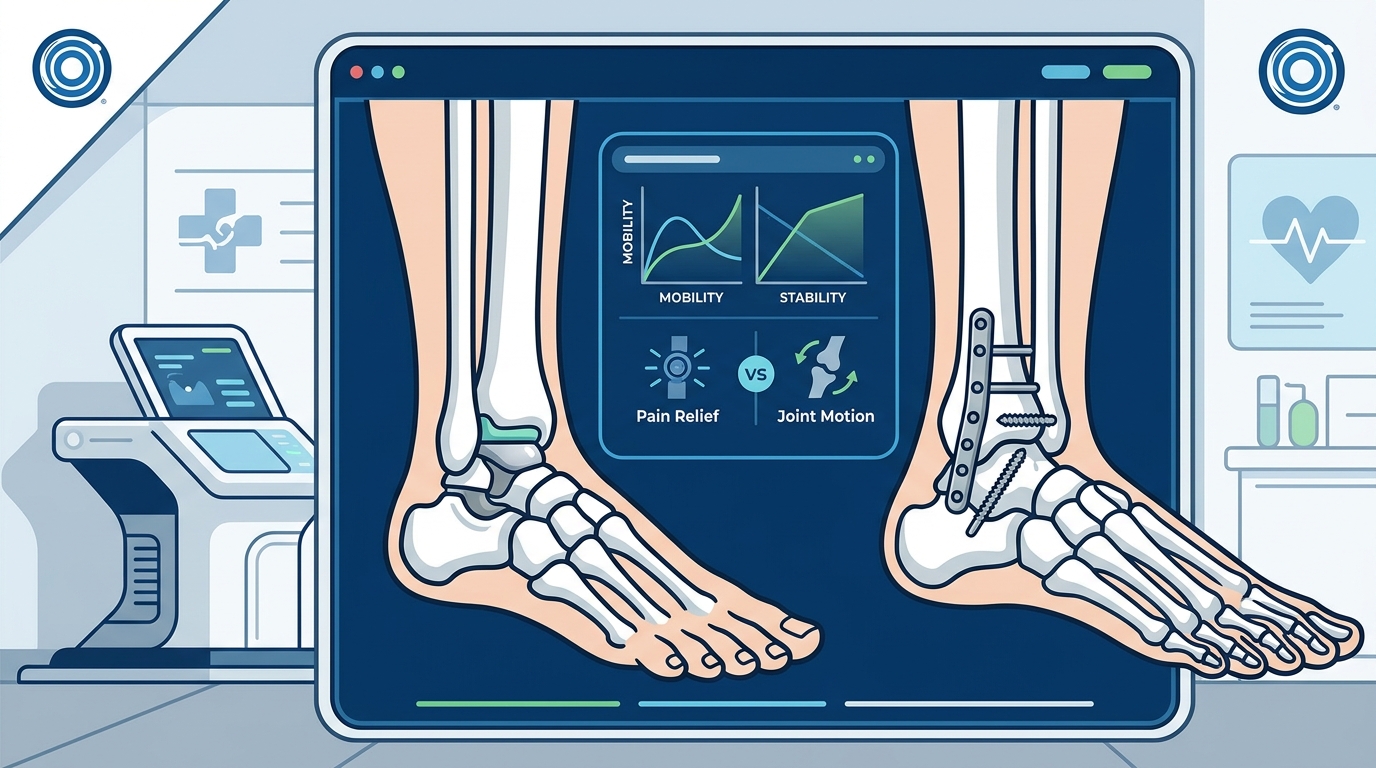
Total ankle replacement, also known as total ankle arthroplasty, is a surgical procedure that replaces the damaged ankle joint with a metal and plastic prosthesis. This procedure aims to preserve motion while eliminating pain. It is generally recommended for patients who are older, have lower activity demands, and have good bone quality. The goal is to restore a natural range of motion, allowing patients to walk comfortably without the stiffness often associated with fusion. For additional details, review the Notice of Privacy Practices.
Candidacy for Ankle Replacement
Not every patient with arthritis is a candidate for replacement. Ideal candidates typically have isolated ankle arthritis without significant deformity in the hindfoot. Bone quality is a critical factor, as the implant must be securely fixed to the tibia and talus. Dr. Butler evaluates these factors during the initial consultation to determine if replacement is the best path for your specific anatomy.
Recovery and Outcomes
Recovery from total ankle replacement involves a period of protected weight-bearing, usually in a boot or cast. Most patients experience significant pain relief within the first few months. Long-term studies show that modern implants have high survival rates, allowing patients to return to daily activities like walking, swimming, and cycling. The procedure is less invasive than fusion in terms of motion loss, but it requires careful adherence to post-operative protocols to protect the implant.
Ankle Fusion
Ankle fusion, or arthrodesis, is a surgical procedure that joins the bones of the ankle joint together so they heal as a single, solid bone. This eliminates motion in the ankle joint, which removes the pain caused by bone-on-bone friction. Fusion is a durable, long-lasting solution that is often recommended for younger, more active patients or those with significant deformity. While it sacrifices ankle motion, the surrounding joints, such as the subtalar and midfoot joints, often compensate to allow for functional walking.
When Fusion is Preferred
Fusion is often the preferred option for patients with severe arthritis that extends beyond the main ankle joint into the hindfoot. It is also a robust choice for patients with a history of trauma or previous surgeries that may compromise the stability of an implant. The procedure is highly reliable, with low failure rates, and provides a permanent solution to pain. Patients often report that while they cannot bend their ankle, they can walk and stand comfortably without pain.
Recovery and Adaptation
The recovery process for ankle fusion is similar to replacement, involving a period of non-weight-bearing or protected weight-bearing. The primary difference is the adaptation period, where patients learn to walk with a stiff ankle. Physical therapy plays a crucial role in strengthening the surrounding muscles and improving gait mechanics. Most patients find that their quality of life improves significantly once the pain is resolved, even with the loss of ankle motion.
Surgical Options Comparison
Choosing between total ankle replacement and ankle fusion depends on individual patient factors. The following table summarizes the key differences between the two procedures to help you understand the trade-offs involved.
| Feature | Total Ankle Replacement | Ankle Fusion |
|---|---|---|
| Primary Goal | Pain relief with preserved motion | Pain relief with joint stabilization |
| Ideal Candidate | Older, lower activity, good bone quality | Younger, active, or significant deformity |
| Motion Preservation | Yes, restores natural range | No, joint is immobilized |
| Longevity | High, but may require revision | Very high, permanent solution |
| Recovery Focus | Protecting the implant | Adapting to stiff gait |
Key Takeaways
- Dr. Leroy Butler is a fellowship-trained orthopedic surgeon specializing in foot and ankle care in Frisco and Dallas.
- Total ankle replacement preserves motion and is ideal for patients with good bone quality and lower activity levels.
- Ankle fusion eliminates pain by immobilizing the joint and is a durable option for active patients or those with deformity.
- Candidacy for surgery depends on the extent of arthritis, bone health, and patient goals.
- Both procedures offer significant pain relief and improved quality of life.
- Recovery involves a period of protected weight-bearing and physical therapy.
- Consulting with a subspecialist ensures the right surgical option is chosen for your specific anatomy.
Frequently Asked Questions
Who is the best surgeon for ankle arthritis in Frisco?
Dr. Leroy Butler, DO, FAAOS, is a foot and ankle fellowship-trained orthopedic surgeon who provides subspecialty care for ankle arthritis in Frisco. His expertise in advanced ankle care makes him a suitable choice for complex cases.
What is the difference between ankle replacement and fusion?
Replacement replaces the joint with an implant to preserve motion, while fusion joins the bones together to eliminate motion. Replacement is often for older patients, while fusion is for younger or more active patients.
How long does recovery take for ankle surgery?
Recovery typically involves 6 to 12 weeks of protected weight-bearing. Full recovery and return to normal activities can take several months, depending on the procedure and individual healing.
Is ankle fusion a permanent solution?
Yes, ankle fusion is a permanent solution. Once the bones heal together, the joint does not move. This provides a long-lasting relief from pain.
Can I walk after total ankle replacement?
Yes, you can walk after total ankle replacement. The goal is to restore a natural range of motion, allowing for comfortable walking without the stiffness of a fused joint.
Where is the practice located?
The practice has locations in Frisco and Dallas, Texas. The Frisco office is located at 5575 Warren Parkway, Suite 115.
Next Steps for Frisco Patients
If you are experiencing chronic ankle pain and have been diagnosed with end-stage arthritis, it is time to explore your surgical options. At Leroy Butler, DO PLLC, we provide personalized care tailored to your specific needs and goals. Whether you are considering total ankle replacement or ankle fusion, our team will guide you through the decision-making process. To schedule a consultation, please contact our office at (972) 591-6468. We are committed to helping you regain your mobility and quality of life.