

Minimally invasive bunion surgery (MIS) offers faster recovery and less pain, but traditional open surgery remains the gold standard for severe deformities. At Leroy Butler, DO PLLC, we help patients in Dallas and Frisco determine which approach fits their specific anatomy. The right choice depends on bone quality, deformity severity, and your lifestyle goals, not just the incision size.
Traditional Open Bunion Surgery
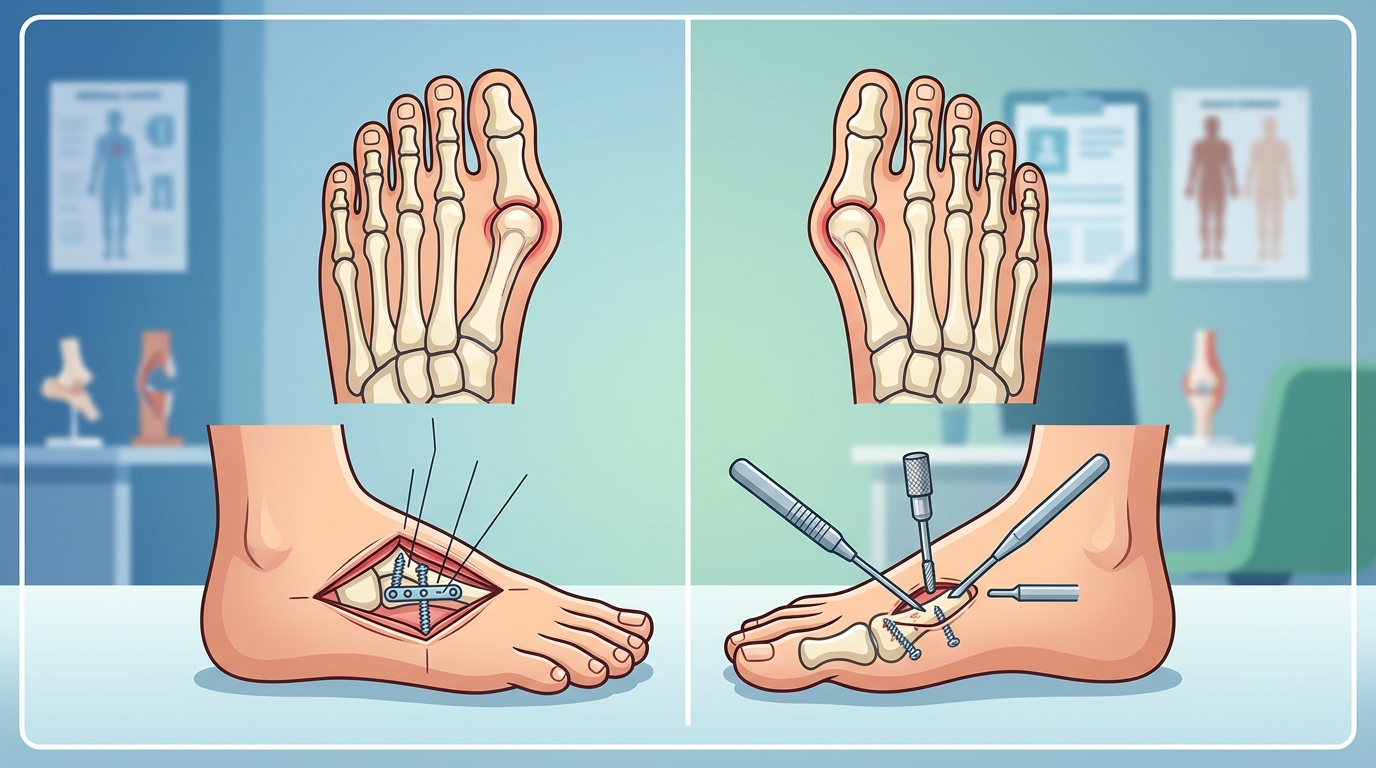
Traditional bunion surgery is a procedure where the surgeon makes a single, larger incision to directly visualize and correct the bone and soft tissue structures. This method has been the standard of care for decades because it allows for precise realignment of the metatarsal and phalanx bones. The surgeon can see exactly where the bone cuts are made, ensuring stability in complex cases. For additional details, review the Accessibility Statement Leroy Butler.
Strengths of Open Technique
The primary advantage of open surgery is direct visualization. The surgeon can assess the joint integrity and correct associated issues, such as tendon imbalances, in real-time. For patients with severe hallux valgus or poor bone quality, this visibility is critical for a stable, long-lasting result.
Limits and Recovery
The larger incision leads to more post-operative pain and swelling. Recovery typically involves a non-weight-bearing period or a stiff-soled boot for several weeks. Scar tissue formation is more pronounced, which can sometimes limit toe motion if not managed with aggressive physical therapy.
Minimally Invasive Bunion Surgery (MIS)
Minimally invasive bunion surgery is a technique that uses small percutaneous incisions and specialized instruments, such as a burr, to correct the deformity without fully exposing the joint. According to HSS Health Library, this approach allows cuts to be made through tiny incisions, minimizing disruption to surrounding soft tissues.
Strengths of MIS
MIS preserves the blood supply and soft tissue envelope around the joint. This often results in less pain, smaller scars, and a faster return to normal activities. Patients can often begin weight-bearing in a surgical shoe sooner than with open techniques.
Limits and Suitability
MIS is not suitable for every patient. It requires good bone quality and a deformity that can be corrected without extensive soft tissue release. In older patients or those with significant arthritis, the limited visibility can make precise correction more challenging. Research published in PMC notes that bunion deformity affects more than 35% of people over 65, and surgical correction in this population can be complicated by poor bone quality.
Comparison of Surgical Techniques
| Criteria | Traditional Open Surgery | Minimally Invasive (MIS) |
|---|---|---|
| Incision Size | Single, larger incision (2-3 inches) | Multiple small incisions (0.5-1 cm) |
| Soft Tissue Disruption | Higher; requires retraction of tissues | Lower; preserves tissue envelope |
| Pain Management | Higher initial pain; often requires oral meds | Lower initial pain; often managed with ice/elevation |
| Weight-Bearing | Delayed; often 2-4 weeks in boot | Earlier; often immediate in surgical shoe |
| Best For | Severe deformities, poor bone quality, arthritis | Moderate deformities, good bone quality, active patients |
Choosing the Right Approach for You
Selecting the correct technique is a clinical decision based on your specific anatomy. At Leroy Butler, DO PLLC, we use advanced imaging to evaluate your bone structure before recommending a plan.
Choose Traditional Open Surgery If:
- You have a severe bunion deformity (hallux valgus angle > 40 degrees).
- You have significant arthritis in the big toe joint.
- Your bone density is low (osteoporosis), requiring robust fixation.
- You have had previous foot surgeries that altered the anatomy.
Choose Minimally Invasive Surgery If:
- You have a moderate bunion with good bone quality.
- You want to minimize downtime and return to work quickly.
- You are concerned about large scars or significant post-op pain.
- You are an active individual who wants to resume low-impact activities sooner.
Frequently Asked Questions
Is minimally invasive bunion surgery safer than open surgery?
Both techniques are safe when performed by an experienced surgeon. MIS may have a lower risk of wound complications due to smaller incisions, but open surgery allows for more precise correction in complex cases. Safety depends heavily on patient selection and surgeon expertise.
Can I switch from MIS to open surgery if the result is not ideal?
Yes, but it is more complex. If a MIS procedure does not achieve the desired correction, a revision surgery may be required. This often involves converting to an open approach to fully visualize and correct the remaining deformity. This is why initial patient selection is critical.
How long does recovery take for each method?
Traditional open surgery typically requires 6-8 weeks in a boot before transitioning to normal shoes. MIS patients may transition to normal shoes in 3-4 weeks, though full healing takes several months for both. Individual recovery varies based on bone healing rates and compliance with protocols.
Does insurance cover minimally invasive bunion surgery?
Most insurance plans cover bunion surgery when it is deemed medically necessary, regardless of the technique. However, some plans may have specific requirements or prior authorization processes for MIS. It is important to verify your benefits with your provider before scheduling.
Who is a good candidate for bunion surgery at all?
Good candidates are patients with persistent pain that does not respond to conservative treatments like orthotics or wide-toe shoes. The decision to operate should be based on pain and function, not just the appearance of the bunion. A fellowship-trained surgeon can help determine if surgery is the right next step.