
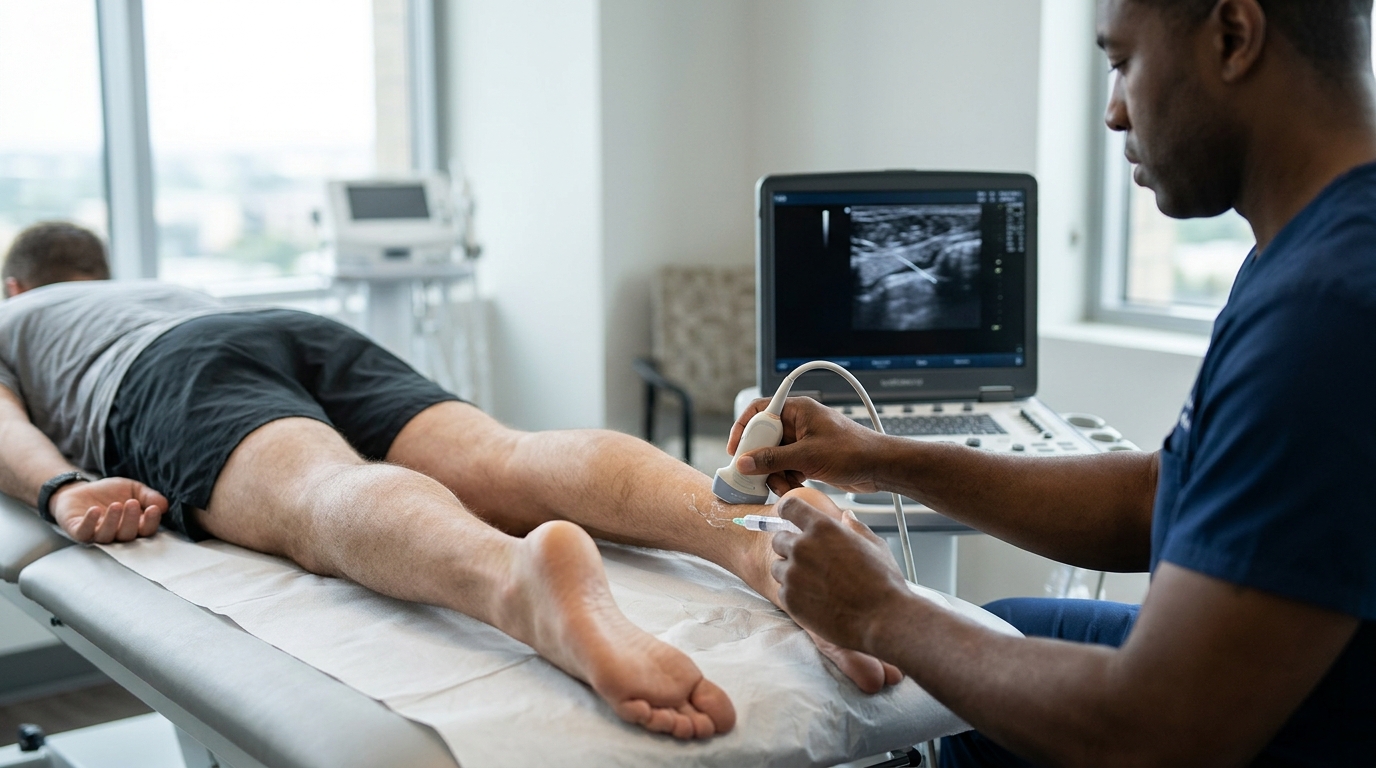
Ultrasound-guided Achilles tendon injections are more effective than traditional landmark-based methods because they allow the clinician to visualize the tendon in real time, ensuring the medication reaches the exact site of pathology. This precision avoids damaging nearby nerves and blood vessels, which can occur when relying solely on anatomical landmarks. At Leroy Butler, DO PLLC, we utilize this advanced imaging technology to maximize therapeutic outcomes for patients in Dallas and Frisco.
The Complexity of Achilles Tendon Anatomy
The Achilles tendon is not a simple rope of tissue. It is a complex structure with distinct zones, including the insertional area where it attaches to the heel bone and the non-insertional mid-portion. Achilles tendinopathy is a degenerative condition characterized by disorganized collagen fibers and microtears, often resulting in chronic pain and swelling. Traditional injection methods rely on palpation and surface landmarks, which can be misleading due to individual anatomical variations. For additional details, review the Notice of Privacy Practices.
When a clinician injects without imaging, there is a risk of missing the target zone entirely. This can lead to the medication being deposited in the surrounding fat or muscle rather than the tendon itself. In some cases, the needle may inadvertently penetrate the tendon, causing a rupture. By understanding the specific zone of injury, we can tailor the injection to the precise area of degeneration. For additional details, review the Accessibility Statement Leroy Butler.
Real-Time Visualization and Accuracy
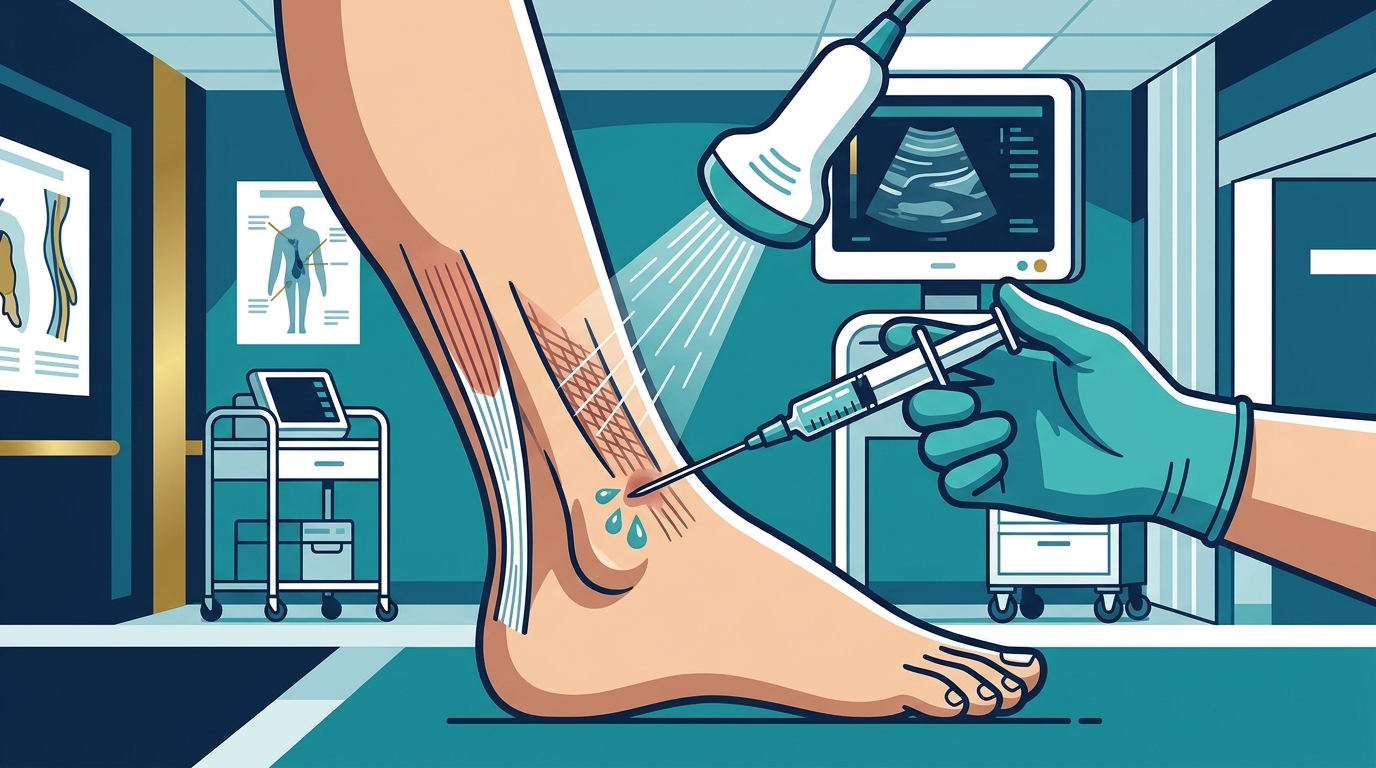
Ultrasound guidance provides a live view of the needle as it approaches the tendon. Image-guided injection is a technique that uses real-time imaging to direct a needle to a specific target within the body. Studies have shown that ultrasound-guided injections in the foot and ankle are 100% accurate in avoiding intervening neurovascular and tendinous structures, a level of precision not achievable with blind techniques. This accuracy is critical because the Achilles tendon is surrounded by sensitive nerves and blood vessels.
For example, a study on ultrasound-guided minimally invasive surgery for Achilles tendon rupture highlighted that real-time soft tissue visualization allows for smaller surgical wounds and better outcomes. While this study focused on surgery, the principle of visualization applies directly to injections. Seeing the needle tip ensures that the therapeutic agent is delivered exactly where it is needed, maximizing the biological effect of the treatment.
Safety Profile and Risk Mitigation
Safety is the primary driver for adopting ultrasound guidance in orthopedic care. The traditional landmark method carries a higher risk of iatrogenic injury, such as nerve damage or vascular puncture. Ultrasound allows the clinician to identify these structures before the needle enters the tissue. This is particularly important in the ankle region, where the sural nerve and posterior tibial vessels are in close proximity to the tendon.
Research indicates that office-based ultrasonography has become increasingly available and is widely used to guide joint and soft tissue injections. By avoiding these critical structures, we reduce the risk of complications that could delay recovery or cause permanent damage. Patients can feel confident that the procedure is performed with the highest standard of care, minimizing the potential for adverse events.
Clinical Outcomes and Functional Recovery
The ultimate goal of any injection is pain relief and functional improvement. Ultrasound-guided injections have been associated with better clinical outcomes in various tendinopathies. A case report on post-surgical repair noted that real-time ultrasound confirmed gradual improvement in tendon gliding, leading to marked functional recovery. The patient in this case achieved the ability to perform single-leg heel raises and toe walking, with sustained benefits observed at follow-up.
Key Takeaways
- Ultrasound guidance ensures 100% accuracy in avoiding neurovascular structures during foot and ankle injections.
- Real-time visualization allows for precise delivery of medication to the specific zone of tendon pathology.
- Traditional landmark-based methods carry a higher risk of missing the target or causing iatrogenic injury.
- Image-guided techniques are supported by extensive research demonstrating improved safety and efficacy. according to Frontiers Efficacy of
- Accurate injection placement can lead to better functional outcomes, such as improved gait and reduced pain.
- At Leroy Butler, DO PLLC, we combine fellowship-trained expertise with advanced imaging for optimal care.
Frequently Asked Questions
Is an ultrasound-guided injection painful?
The procedure itself is generally well-tolerated. The ultrasound probe may cause slight pressure, but the injection is similar to a standard medical injection. Local anesthetic is often used to minimize discomfort during the procedure.
How long does the procedure take?
What medications are used in these injections?
Common medications include corticosteroids, platelet-rich plasma (PRP), or hyaluronic acid. The choice of medication depends on the specific diagnosis and the stage of the tendinopathy. Your physician will discuss the best option for your condition.
Can ultrasound guidance detect a tendon rupture?
Yes, ultrasound is highly effective at detecting partial or complete tendon ruptures. If a rupture is identified during the imaging process, the injection is not performed, and a different treatment plan is discussed.
How many injections are usually needed?
Most patients require only one or two injections for significant pain relief. The number of injections depends on the severity of the condition and the patient's response to the initial treatment. Your physician will monitor your progress and adjust the plan as needed.
Is this procedure covered by insurance?
Coverage varies by insurance plan. Many plans cover ultrasound-guided injections when deemed medically necessary. We can help you verify your benefits and provide the necessary documentation for prior authorization.
Conclusion
Ultrasound-guided Achilles tendon injections represent the gold standard in minimally invasive orthopedic care. By leveraging real-time imaging, we ensure that every injection is safe, accurate, and effective. If you are experiencing chronic heel pain or have been diagnosed with Achilles tendinopathy, consider the benefits of image-guided treatment. To schedule a consultation and learn more about our advanced care options, contact our team at Leroy Butler, DO PLLC.